Telephony · Career
From copper to fiber
Alongside the mailbox ran my path through telephony. At night I ran mailbox polls and answered user requests, by day I pulled cable and set up telephone systems. Same technology, two lives.
Did you know?
It begins with the telegraph: Samuel Morse developed the electric telegraph in the 1830s and, with Alfred Vail, the code named after him in 1838 — letters as a sequence of short and long pulses. On May 24, 1844, the first line between Washington and Baltimore went into service. For the first time, a message traveled faster than a messenger.
The next step was speech itself. The German teacher Philipp Reis built the first device to transmit tones over a wire in 1861 — and coined the word "Telephon" for it. He deliberately chose a nonsense test sentence so no one could guess it instead of actually hearing it: "The horse eats no cucumber salad." Clear speech was still beyond it.
That breakthrough came from Alexander Graham Bell: he received the patent for the telephone on March 7, 1876, and a few days later spoke the first intelligible words to his assistant Watson. Pulses on a wire had become a voice — and from that idea grew the network I plugged my modem into a good hundred years later.
A borrowed modem
It all started in July 1989, at a barbecue held by the Amiga User Group Liechtenstein. Someone talked about modems and mailboxes, completely new to me. A friend lent me his SupraModem 2400 for a week. I hooked it up at home, and my parents' phone line was tied up constantly for a week. Cost: nearly 200 CHF for that week. I was still in school. It hooked me anyway, and shortly after I bought my own.
The 1,200-franc bill
In 1990 I started training as an electrician. Telephony was only a small, very basic part of it there. Privately I had long since moved on to a USRobotics Courier 9600 HST, a huge leap over the Supra. I now had my own line — and the bill only arrived every two months, which made the shock even bigger.
One time a bill for nearly 1,200 CHF landed in the mailbox. I called Telecom PTT, insisting it couldn't be right. They sent me the itemized statement on tractor-feed paper with punched edges, one line per call: 32 landscape-printed A4 pages, nearly 1,000 connections. It was correct. And this on an apprentice's wage, which was well below that amount back then.
From user to sysop
In spring 1991 the same friend showed me his own mailbox. That tipped the scales. I was fairly reserved, and the mailbox became my way of getting involved. That's how Empire BBS came to be. Now I needed more lines, since one line gets you nowhere, plus routing for Fidonet and the other networks.
One side detail that shows how early all this was: in June 1991 my first own online bank transfer ran over a videotex terminal and Telegiro PTT. Years before the public internet.
ISDN, on my own
In 1992 ISDN became viable in Switzerland. I had my employer order the documentation from Telecom PTT and installed the line myself, to spec, at my own home. My boss asked what it even was, he'd never heard of it. By the end of 1992 my first ISDN line was running, likely one of the first in Liechtenstein. The Amiga held an ISDN Master card, and the software WilhelmTEL, of which I was a beta tester, handled the calling.
For the mailbox this changed everything. No more dial-up, just click and connected. Faster, but also pricier, since more connections went through in the same amount of time.
ISDN didn't just change the mailbox, though — it changed my entire working life. Until then, the rule in Liechtenstein was: one company, one phone number, and every number hung on its own analog line. At addresses with many registered companies, that quickly meant twenty or thirty phones crammed into one room, each labeled with its company's name — and I was the one pulling all those lines. With ISDN, lines and numbers could suddenly be booked independently of each other, and a room full of phones turned into a few lines carrying an entire block of numbers. How that worked technically is covered under ISDN & PBX.
From hobby to profession
After finishing my training in 1994, I moved fully into telephony technology in October 1995. Service first, then telephone systems. It was a strange time. Customers would tell me about the new thing, the internet, ISDN. And I'd sit there thinking, I've had that since the early 90s. It wasn't new, it was just slowly becoming public knowledge.
The boom, and the beginning of the end
1996 brought the internet boom, still dial-up. Of all things, the technology I'd long since been installing gradually pulled people away from the mailbox. Users dwindled, costs stayed the same. Still, I kept Empire running for years, out of idealism and because I had a role as a hub in the networks. Only in 1999 did I draw the line.
Two endings at once
In 1999 I shut Empire down for good, the Amigas went into the basement. The Amiga was finished anyway, Commodore long bankrupt, and with it an entire world. In October 1999, my job as a telephone technician ended too. In early 2000 I moved into IT as an employee, and in October 2000 I went self-employed — the foundation of my own company.
From copper to glass
Professionally, the journey went on. Toward the end of the 90s came ADSL, the first always-on connection at a fixed cost, a big leap. Then VDSL, still over copper. And in 2018/19, fiber, with a gigabit and more, later up to 25. From 2,400 baud to 25 gigabit, that was my journey.
Stories from the analog era
Alongside the straightforward career path there are the small episodes that stick — tricks, quirks, and aha moments from a technology that no longer exists in this form. They sit outside the timeline, because they don't belong to any single year, but to the whole era.
The Teletester
One tool accompanied me through the whole analog era: the Teletester, essentially a small test handset. You'd tap into a line with it to trace it in the distributor frame — high impedance made a diode indicate ringing, low impedance let you listen in over the speaker.
Once I was at a customer's site to connect an analog line. While probing, my hand slipped on the contacts, and the speaker played back: "This number is invalid." My colleague laughed and asked if I was trying to dial a number. I just smiled, tapped out his cell number with the Teletester at the right rhythm — the test contact acts like the hook switch, which is nothing more than pulse dialing by hand. When his phone rang, I said, "When I want to dial a number, I dial one." He was pretty stunned.
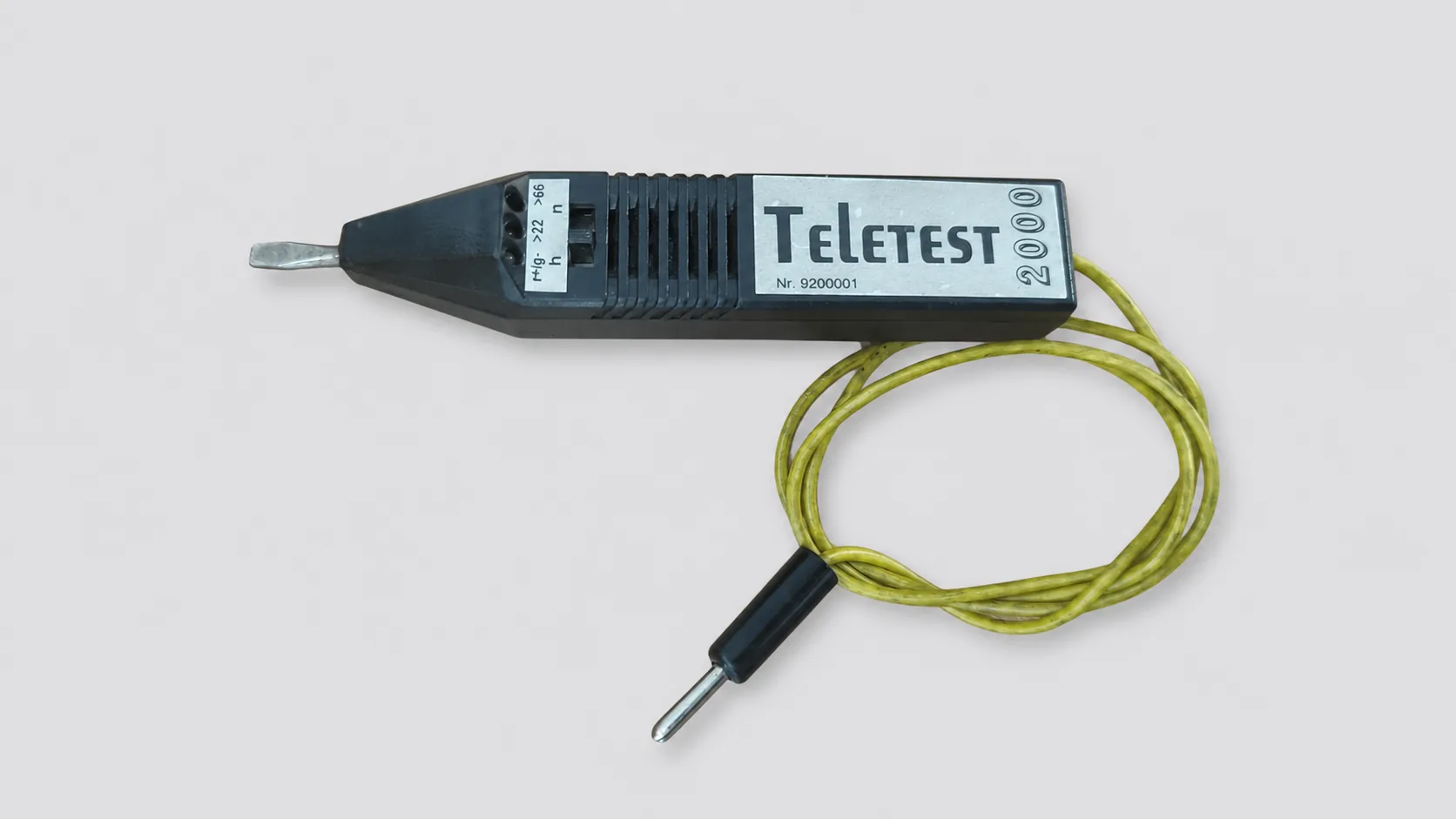
Teletester
The test handset — one of the most important tools of the analog era.
The remote that could do too much
The first better answering machines came with a small remote control: a tone generator that played the tones of touch-tone dialing. You'd hold it up to the handset's microphone and could check your answering machine from anywhere — even from a phone that itself only did pulse dialing. Handy, since touch-tone wasn't available everywhere back then, not by a long shot.
Resourceful people quickly noticed that such a tone generator did nothing more than produce DTMF tones — the very tones used to dial. In phone booths, that let you dial a number without dropping in a coin. That didn't go unnoticed: later, public payphones were rebuilt so the microphone only activated after the connection was established. That put an end to the trick. Public phones themselves are history today, for that matter.
The blocked line
Under the old analog technology, one simple rule applied: the connection stayed up until the caller hung up. If only the called party hung up, the line stayed occupied. This was called clear-back — and whoever knew about it could exploit it.
Stories circulated about taxi drivers who'd drop a five-franc coin into a payphone, call a rival dispatch center, and then simply not hang up. The competitor's line stayed blocked for as long as the connection held — and customers ended up calling whoever they could actually get through to. It only got fixed once the technology switched to release-on-either-end: since then, either side hanging up reliably ends the call.
// Technology in detail
I've gathered the devices and standards behind all this on their own pages.
- Lines & jacks — 4-wire jack, TT83, GA relays, distributors.
- ISDN & PBX — Telephone systems, NT-2ab, ISDN routers.
- Phones — From the rotary dial through DTMF to ISDN and cordless.