Technology in Detail · Modems
Modems
A modem turned computer data into tones and back again, so it would fit down a phone line. Its whistle and hiss during connection setup was the sound of a whole era. And its speed was the hard currency of every mailbox.
The beginning: Supra 2400
It started in 1989 with a Supra 2400. It was a cheap modem at 2400 baud, and of all places it first hit the line at a barbecue. The nickname "Gorbi" was born around the same time. It wasn't fast. A single high-resolution photo file would have taken many minutes with it. But it worked, and it was the entry into the online world.
The first dial-in was an adventure in itself. The modem had a cable with only a red and a green wire sticking out – my first encounter with a phone socket. I clamped the two wires onto the old 4-hole socket, opened JR-Comm and dialed in for the very first time – into the AUGL mailbox. It was my parents' line: if anyone picked up the receiver, the modem hissed – which pleased neither side.
→ The whole story: First Contact
The workhorse: USRobotics Courier
Running a mailbox took robust, fast modems. Almost inevitably those came from USRobotics. The first Courier, at 9600 bps, cost a proud 1000 CHF; over the years 14,400 and 28,800 bps line rates followed. The serial interface to the Amiga ran at up to 38,400 bps, and with data compression throughput got close to that. The Couriers were considered indestructible and ran at Empire BBS several at a time on a 6-port serial card.
One abbreviation keeps coming up: HST. That was USRobotics's own proprietary high-speed scheme. "Dual Standard" modems supported HST and the official standard, a CCITT norm such as V.32bis. The CCITT was the international standards body for telephone technology at the time, known today as the ITU-T. You had to know these fine points, because two modems only understood each other if they found a scheme in common.
How the scene cataloged it
How much these modem abbreviations were part of daily life shows in the legend of the DreamList: the Swiss mailbox directory painstakingly explained to its readers which abbreviation stood for which protocol.
BAUD     | Um die Liste auch weniger versierten Usern zugaenglich zu machen
         | befinden sich in der vorderen Spalte nur die CCITT-Normen sowie
         | die gebraeuchlichsten "Fremd-Protokolle":
         |
         |  2.4 - max. V.22bis
         |  9.6 - max. V.32
         | 14.4 - max. V.32bis
         | 28.8 - max. V.34
         | HST  - max. V22bis sowie US Robotics HST-Protokoll
         |
         | In der letzten Spalte weitere Infos zu Modems mit Fremdprotokollen:
         |
         | USREV- USRobotics 28.8 V.Everything
         | DUAL - USRobotics DUAL
| USR21- USRobotics Courier 21600How fast was that?
And what did that mean in numbers? Here's the raw speed, each in its contemporary unit and in Mbit/s for comparison.
The bar is logarithmic. On a normal scale the modems would be invisible next to fiber.
You did not have to read those numbers off a screen. The two modems negotiated the speed while the connection was being set up, and you could hear it. 2400 was done within seconds. From 9600 on, echo cancellation was added. At 28800 came the short, bright ping that measured the line. Anyone who had heard it often enough knew the speed before CONNECT appeared on the screen.
The devices
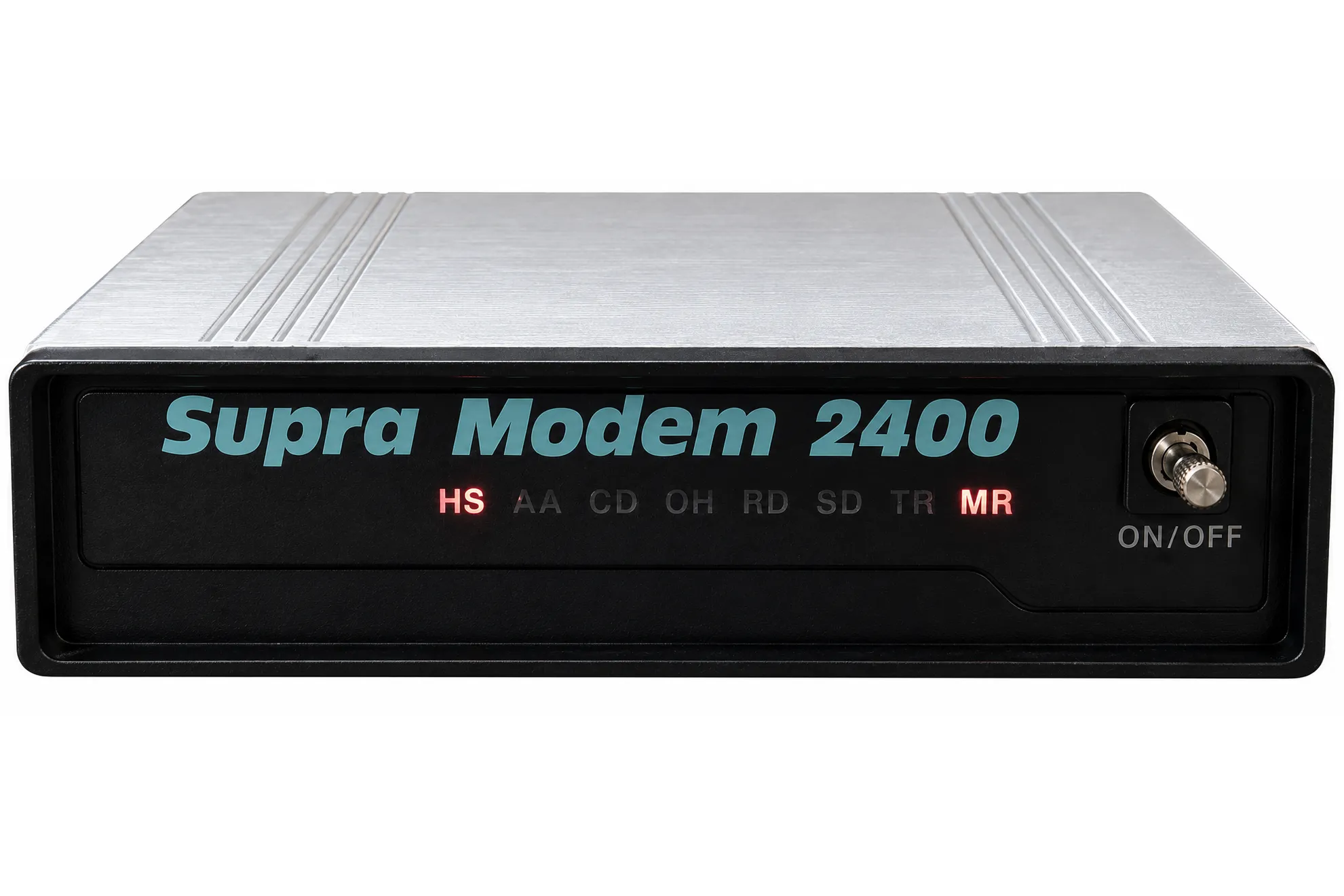
SupraModem 2400My first test modem, from 1989. 2400 baud. 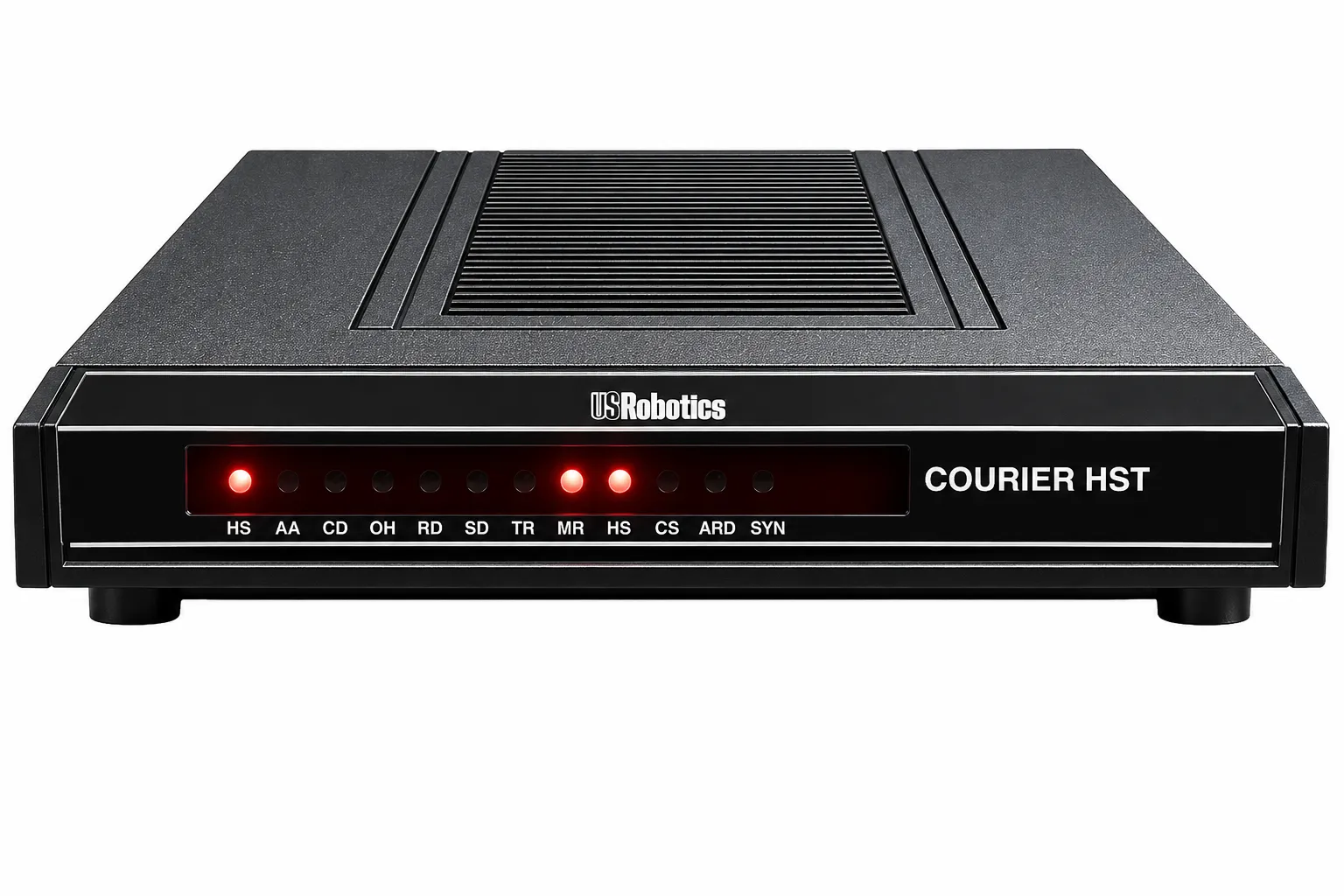
USRobotics Courier HSTMy workhorse, 9600 bps. Several units running at once.