Telephony · ISDN & PBX
ISDN & PBX
A phone system, PBX for Private Branch Exchange, is a company's own switch. It connects the internal handsets with each other and with the public network. Two things shaped this craft: how you configured the system, and how ISDN made the line digital. I installed both from the ground up.
Phone systems and how you configured them
How you configured a system moved, over the years, from the soldering iron to the browser.
- analog · solderingThe first phone systems were Autophon line selectors. Every setting was a solder point set by hand.
- analog · jumpersThen came simpler systems like the Casatel, configured with jumper wires instead of soldering.
- analog · system phoneThe Ascotel line from Ascom, for small to mid-sized phone systems, was programmed directly from the Crystal system phone.
- analog/ISDN · laptopBy around 1999, phone systems could increasingly be programmed from a laptop.
- SIP · laptop/browserWith today's SIP systems, configuration runs from a laptop or a browser.
Business trunk or plain ISDN
ISDN came in two sizes. Companies with their own phone system got a primary rate interface. In the past, every number needed its own line, and large businesses had 30 to 40 of them. Now a single 4-wire line was enough, effectively a 2 Mbit/s line with 30 channels at 64 kbit/s each, over which the system managed as many numbers as it liked through extensions.
For households and small offices there was the plain ISDN line. At the end of the line sat the network terminator, in Switzerland the NT-2ab. It provided the digital S0 bus plus two analog a/b ports, which still ran ordinary phones or fax machines. This variant had three to ten phone numbers. ISDN started in 1992 with ten, and cheaper lines with five or three followed later. Most people did not need that many anyway.
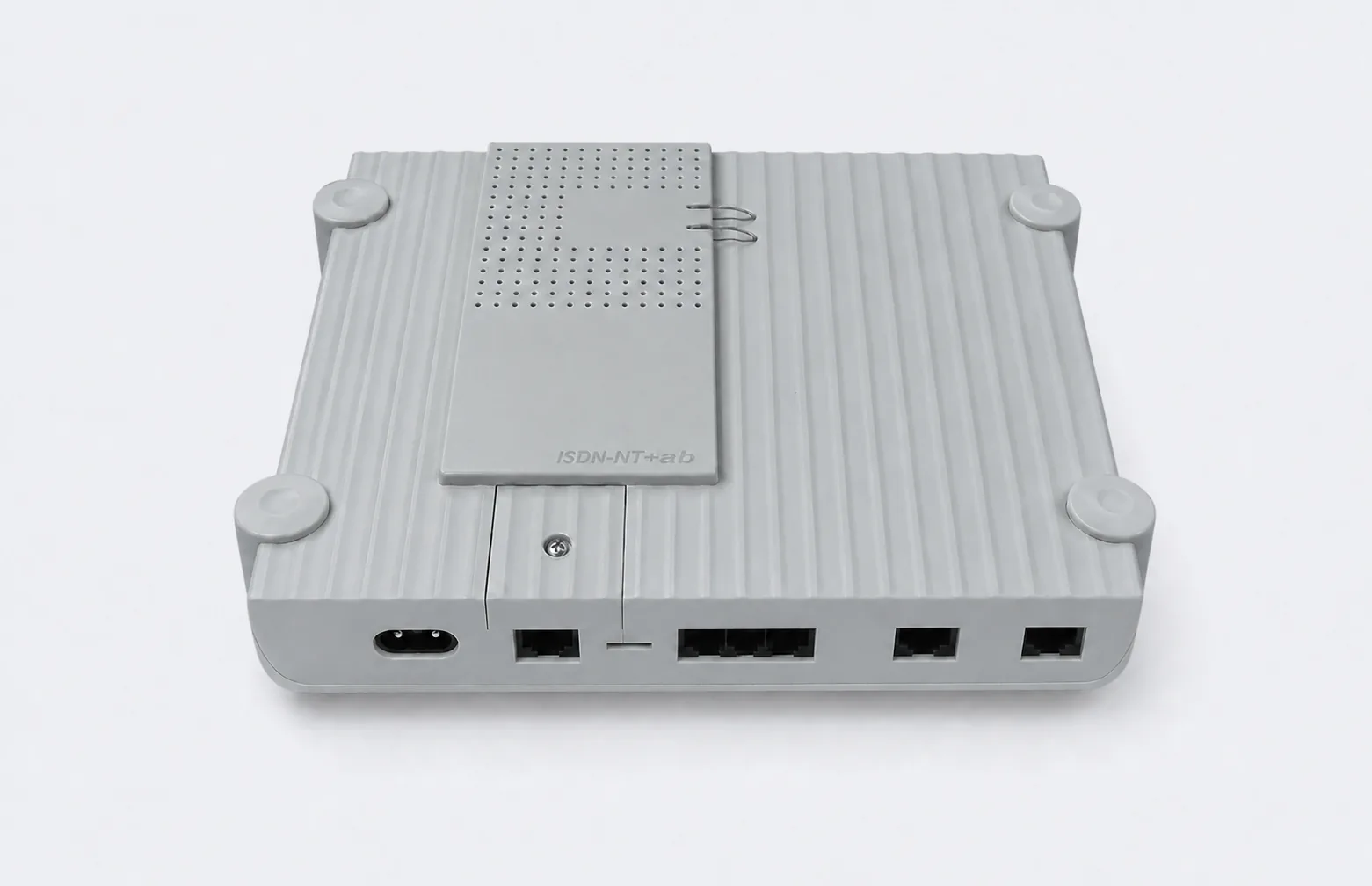
The real breakthrough was that lines and phone numbers could be booked independently of each other. You took the number of voice channels you needed, plus a block of numbers in steps of ten, hundred, or thousand. This showed especially in Liechtenstein, where many holding companies each needed their own number: in the past that meant a whole room full of analog phones, each individually wired and labeled with the company name. With ISDN, two lines and a block of, say, five hundred numbers suddenly sufficed, far cheaper and leaner than five hundred phones with as many installations. The principle still holds today: what was the number block back then is what you book from SIP providers now.
The ISDN router and the dial-up trap
An ISDN router built the connection itself on demand, the moment a device wanted to reach the internet, dial-on-demand was the term. It got tricky with Windows machines, which sent background traffic nonstop. Every few seconds some service wanted onto the network, and each time the router rebuilt the connection.
A telephony customer called me once, his ZyXEL Elite 2864I had landed him a bill for 3,000 CHF. That was no fault of the device. The router did exactly what the PC asked of it: dutifully open the connection on every request and fetch the data from the internet. As a stopgap I installed a switchable outlet for him, so he could turn the router on and off by hand. That was in the mid-90s. He is still a customer today.