Telephony · Phones
Phones
The set itself tells the whole story, above all through one question: how did you dial a number? From the rotary disc to the keypad to the digital comfort device.
From rotary dial to keypad phone
The classic was the Model 70, which the PTT rented out starting in 1977. A rotary-dial phone with pulse dialing, rugged and at home everywhere. It defined the '70s and '80s.
Then came the Tritel series, a joint effort by Autophon, Gfeller and Zellweger, the later Ascom companies. It brought push-button dialing into the home and could be switched between pulse dialing and the new tone dialing (DTMF). The transition from disc to button, in one device.
How a number came together: pulse and tone dialing
Behind "disc" and "button" lie two fundamentally different ways of transmitting a number. Pulse dialing(loop disconnect dialing) is the older of the two: for each digit the line is briefly interrupted the corresponding number of times, three times for a 3, ten times for a 0, at a rate of roughly ten interruptions per second. That is exactly what the rotary dial did as it spun back. Between two digits a short pause is needed; wait too little and they merge into the wrong digit.
The neat part: this interrupting is also done by the hook switch, the button the handset presses down when you hang up. Anyone tapping it at the right rhythm could dial without a rotary disc at all, a trick that people once used to get through from a phone booth even with a blocked dial. The same principle also turned the Teletester used by telephone technicians into an incidental dialing device.
Tone dialing (DTMF) replaced it: each key sends two overlaid tones at once, which the exchange assigns unambiguously to a digit. Faster, more reliable, and the prerequisite for later controlling phone menus, answering machines and other services remotely by pressing a key.
ISDN comfort phones
With ISDN, phone sets went digital and more comfortable: display, caller list, several connections at once. At Ascom they were called Crystal, and Rubin 30 and Rubin 40. The Crystal also doubled as a system phone, used to program the Ascotel systems it was connected to.
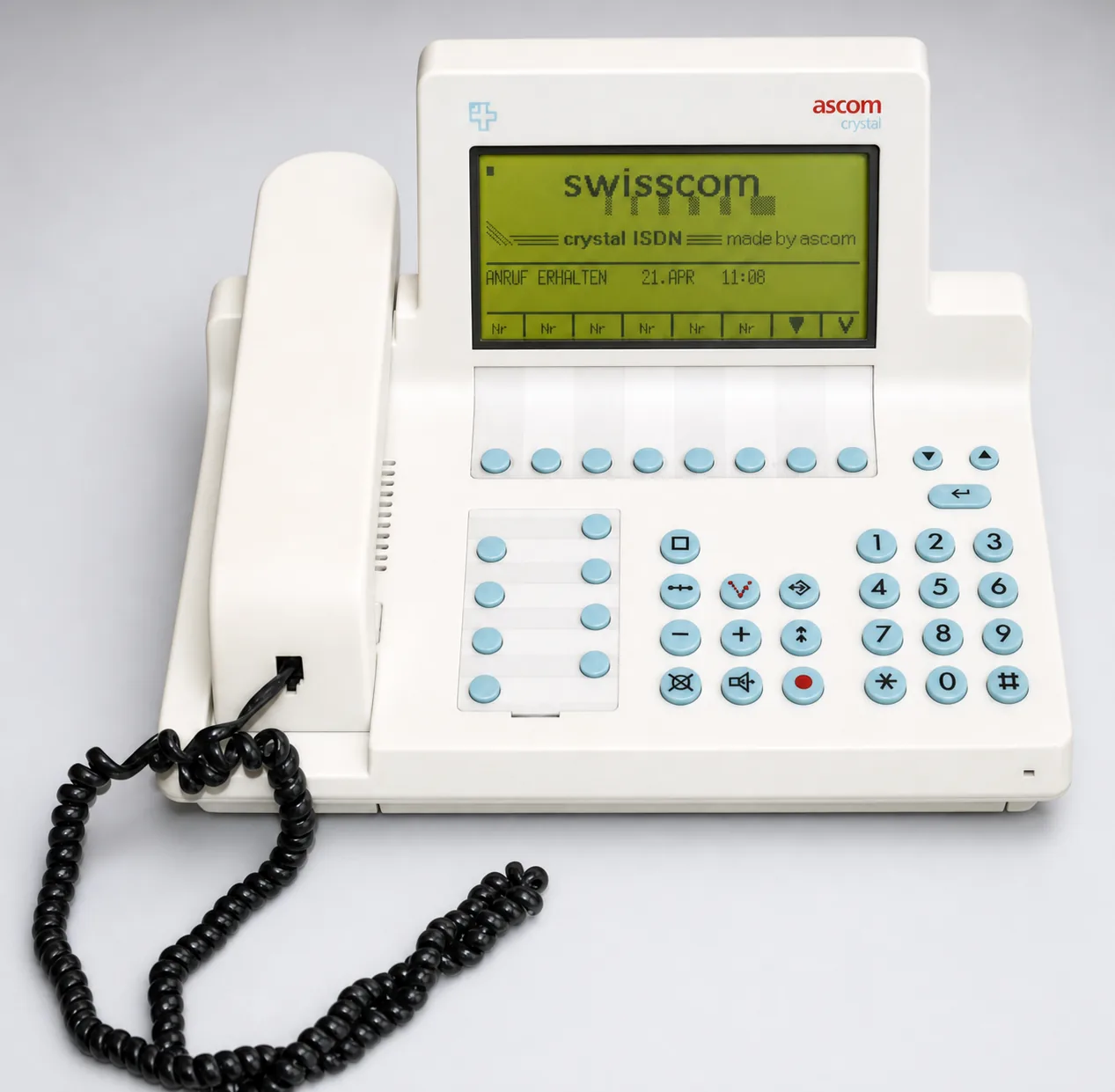
Anecdote: the baffled night caller
Because I had an ISDN line early on, the Crystal showed me the caller's number – long before that became standard. One night at two, someone called several times and hung up each time the moment I picked up. I was at the mailbox anyway, so no big deal – but at some point it got annoying. I simply called the number back and asked the person to stop bothering others at that hour. They were completely baffled: how on earth did I have their number? Caller ID – hardly anyone knew it back then.
Cordless: the first wireless phones
The first cordless devices were still analog, built on the CT1 standard, the precursor to DECT. From Telecom PTT there was the Soloturn, with a pull-out metal antenna, and later the smaller flip-open Mesocco. Instead of a jack in every room, all you needed was a single base station; the radio link did the rest.
A detail hardly anyone thinks about today: because CT1 transmitted in analog, it could be listened in on with a simple radio scanner. Anyone in the neighborhood who wanted to eavesdrop needed little more than a radio. It took digital DECT to bring encryption and put a stop to that. That it turned out to be weak, years later, is another story.
Anecdote: the forgotten gratitude
When the hype around cordless phones took off, I was installing them almost daily. One of them was for an elderly lady. I plugged everything in and explained the functions – back then that meant dialing, redial and storing a few numbers. She thanked me and pressed a twenty-franc note into my hand for the explanation. Back at the office, not ten minutes later, my colleague asked me what on earth had happened. "Why?" The lady had called in to complain that I had left without explaining the phone to her. I just dryly asked whether I should bring the tip back – it had, after all, been for the training.