Tech in detail · ISDN-Master & WilhelmTEL
ISDN-Master & WilhelmTEL
When my first own ISDN line arrived in 1992, I needed a piece of hardware to hang the Amiga onto the digital network. The answer was an expansion card with the pretty name ISDN-Master – and a piece of software that turned it into a full-blown phone.
The card
The ISDN-Master II came from bsc büroautomation AG (hardware) and Relog AG (software); the manual bears the 3rd edition of June 1994. The card plugged into the Amiga and hung off the ISDN line via the S0 bus; a telephone handset and an audio input could be connected directly.
The real trick sat in the software: through the bundled bscisdn.device the card behaved like a perfectly normal modem – it understood the same "AT" commands and was compatible with the Amiga's serial.device. That let terminal and BBS programs use the fast ISDN line without knowing anything about ISDN. They simply "saw" a particularly speedy modem.
WilhelmTEL – the Amiga as a phone
The ISDN-Master came with the program WilhelmTEL (from Relog AG). With a matching handset it turned the Amiga into a genuine ISDN comfort phone complete with answering machine – years before such features became a given. I was one of its beta testers.
According to the manual, WilhelmTEL handled, among other things:
- All basic phone functions: pick up, dial, redial, answer calls, hang up, switch bus sockets
- Switching between multiple calls, call swapping, holding with hold music
- Freely programmable ringtones (melody or sound file) per MSN – each number switchable on its own
- Phone book database with double-click dialing and selective caller ID suppression
- Answering machine with caller-specific greetings, playable back via handset or Amiga speaker
- Call recording, billing with duration and cost
- Runs in the background, activated by hotkey – answers incoming calls on its own
Feature overview paraphrased from the "ISDN-Master II" user manual, 3rd edition 1994 (© bsc büroautomation AG / Relog AG). Reproduced here only as a brief quote for context, not as a complete manual.
The answering machine
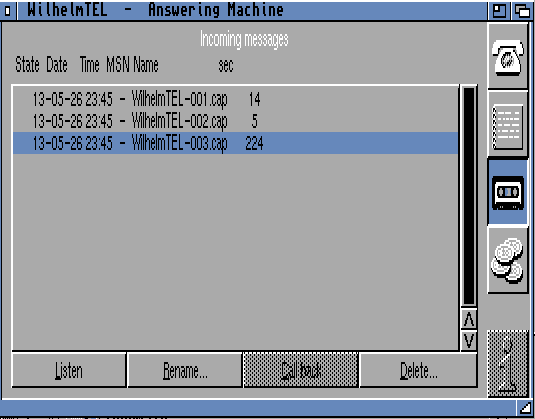
The most tangible part was the answering machine. Incoming messages landed as files on the hard drive, each with date, time, MSN, and length in seconds. Playing back, renaming, calling back, or deleting took one button. On a home machine in 1994, that was anything but ordinary.
Watching the line
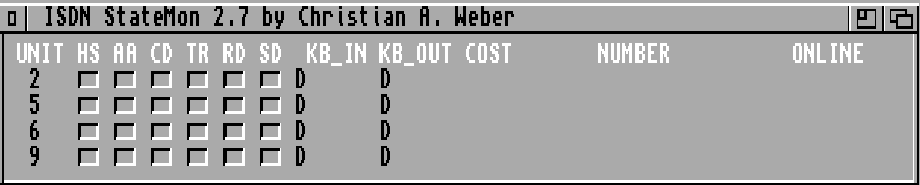
Alongside it ran a small tool, the ISDN StateMon by Christian A. Weber. For each unit it showed the line signals, the kilobytes transferred, the running cost, and the far end. Anyone wanting to know what the line was doing looked here.