Technology in detail · Network
How Fidonet worked
The Fidonet connected thousands of private mailboxes worldwide, with no internet at all. For that to work, it was organized strictly hierarchically. The addresses are built like a postal address, from the world region down to the individual mailbox.
The address reads like a postal address
Every mailbox had a unique address following the scheme Zone:Net/Node.Point. Empire BBS was 2:301/416. Just like a postal address gets more specific going from country through canton and town down to the street, the Fidonet address also goes from broad to specific, from the world region down to the individual mailbox:
The network tree
From the zone down to the individual user, Fidonet forms a tree. The same order as a postal address, from broad to specific.
Why hubs were needed
A node didn't dial every other node directly for each message. With long-distance calls, that would have been unaffordable. Instead, mail was bundled and passed along the hierarchy. That's exactly what hubs were for. A hub is a collection point. It takes in the messages of many nodes and passes them on in a bundle.
The effect was enormous. Instead of a hundred nodes each dialing abroad individually, one international gateway per region made just one expensive international call. It carried the bundled mail of a whole zone.
Polling mostly ran in the evening and at night. There were two reasons for that. During the day, the lines were supposed to stay free. And at night, phone rates were lower. The times were coordinated so a message would move from system to system as fast as possible. That way it reached the whole world within a few days, even though no computer was "online" in today's sense.
Empire BBS wasn't just an endpoint here. In the Amiga networks, the mailbox itself took on a hub role and forwarded mail to other systems.
How that was configured
All of it lived in a single list, the SYSTEMS.CONFIG. It held every counterpart side by side, across all the networks Empire BBS belonged to: Fidonet, AmiNet, Amiganet, and the rest. Whether node, hub, or point, all of them sat in the same list. Every line records the address, the packing format, the handshake method, and whether Empire actively sent the mail or held it for pickup.
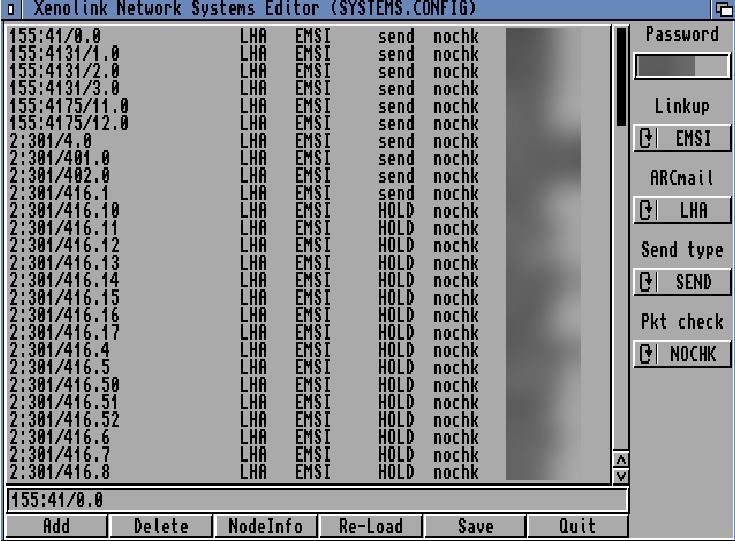
An original document: the Point guide
Anyone who wanted to join as a Point got a guide to read on Empire BBS, written by the sysop himself, in the tone of the early 90s. It explains what a Point is, how to become one, and lists the boards then available across all networks. Here's the original, unchanged (including the Amiga-typical umlaut spelling "ue/ae/oe"):
Show original guide (Empire BBS, ~1993)
Hallo User.

Dich interessiert also, was ein Point ist und wie das vor sich geht.
Also..

Was ist ein Point ?

Ein Point ist ein einzelner User, der die Mitteilungen
der verschiedenen Netze (Aminet, Fidonet, SFNet...) von der
Mailbox runterlaedt und sie dann von zu Hause liest. Danach
kann man Antworten auf irgendeine Mitteilung schreiben, die
dann am Schluss packen und wieder in die Mailbox raufladen.
Natuerlich spart die ganze Prozedur viel viel Zeit (und na-
tuerlich auch Geld).

Wie geht das genau ?

Als erstes must du ein Point-Programm (empfehlenswert ist das
Programm, dass hier auf der Box unter dem Namen Spot11.LHA)
installieren. Vorzugsweise solltest du ueber eine Harddisk ver-
fuegen, da du sonst DJ spielen kannst. Danach bekommst du eine
Point-Nummer von mir (also die gleiche wie ich fuer die Box habe,
einfach mit einem .X hintendran). Danach kannst du angeben,
welche Mitteilungsbretter du beziehen willst. Das Angebot ist sehr
reichhaltig. Im Moment ist der aktuelle Stand bei rund 105 Mitteil-
ungsbrettern und 3 Mitteilungsnetzen.
Auch nachher kannst du jederzeit mit einer Mitteilung die Bretter
ein/ausschalten.

Ist das alles ?

Natuerlich nicht ! Zudem kannst du auch Files per Netzwerk beziehen.
Bei denen handelt es rein nur um PD- und Sharewareprogrammen, die
frei kopiert werden duerfen. Diese kommen auf fast die gleiche Art
rueber wie die Mitteilungen, nur muss man das Zeugs von Hand bearbeiten.


Das gefaellt mir. Wie werde ich nun Point ?

Nichts einfacher als das. Du schreibst mir eine Mitteilung (Hauptmenu L)
und schreibst darin einfach, dass du Point werden willst (oder diese
und jene Frage hast) und ich werde mich mit dir in Verbindung setzen.


Welche Areas gibt es denn ??

Uff, das ist immer schwierig zu sagen. Es kommen laufend dazu. Im
Moment sind folgende Areas zur Verfuegung:

Aminet:
------
PROTECT SOFT.ANT           Alles_ueber_Soft
PROTECT HARDWARE.ANT       Alles_ueber_Hardware
PROTECT AMIGA.ANT          Amiga_Allgemein
PROTECT AMIGA_PRGM.ANT     Rund_ums_Programmieren
PROTECT UNIX.ANT           Rund_um_Unix
PROTECT FLOHMARKT.ANT      Flohmarkt
PROTECT QUASELECKE.ANT     Quasselecke
PROTECT WITZE.ANT          Witze_und_Raetsel
PROTECT MISC.ANT           Diverses
PROTECT DFUE.ANT           Telekom
PROTECT VSDB.ANT           Verein_Schweizerischer_DFUE-Benuetzer
PROTECT VSDB.VOR.ANT       VSDB_Vorstand
PROTECT SAN                Area_zu_den_TickFiles
PROTECT PD.ANT             PD-Listen
PROTECT TEST.ANT           Testarea

Fidonet
-------
PROTECT AMI_ASM.GER        Rund_um_Assembler_(BRD,Fido)
PROTECT AMIGA.CH           Amiga_Allgemein_(CH,Fido)
PROTECT AMIGA.GER          Amiga_Allgemein_(CH,Fido)
PROTECT ANGEBOT.CH         Kommerzielle_Angebote
PROTECT BOERSE.GER         Rund_um_die_Boerse_(BRD,Fido)
PROTECT BOOK.GER           Buecher_(BRD,Fido)
PROTECT CCC.GER            Chaos_Computer_Club_(BRD,Fido)
PROTECT COMPUSERVE.CH      Rund_um_Compuserve_(CH,Fido)
PROTECT ECHO.CH
PROTECT ELEKTRONIK.GER     Elektronik_(BRD,Fido)
PROTECT FLEA.GER           Flohmarkt_(BRD,Fido)
PROTECT FLOHMARKT          Flohmarkt_(CH,Fido)
PROTECT FRUST.CH           Alles_was_frustet_(CH,Fido)
PROTECT HOTLINE.CH         Dringend_gesucht!_(CH,Fido)
PROTECT HST.GER            Alles_ueber_Robotics_(BRD,Fido)
PROTECT ISDN.CH            Rund_um_ISDN_(CH,Fido)
PROTECT ISDN.GER           Rund_um_ISDN_(BRD,Fido)
PROTECT JOKES.GER          Witze_und_Raetsel_(BRD,Fido)
PROTECT JOB.CH             Rund_um_die_Arbeit_(CH,Fido)
PROTECT KOCHEN.GER         Rund_ums_Kochen_(BRD,Fido)
PROTECT KONSOLEN.GER       Alles_uebers_All_(BRD,Fido)
PROTECT MAGIE.GER          Alles_ueber_Magie_(BRD,Fido)
PROTECT NET.301            Alles_uebers_301er_Netz_(CH,Fido)
PROTECT PINBALL.GER        Notizbrett_(BRD,Fido)
PROTECT POINT.CH           Alles_ueber_Points_(CH,Fido)
PROTECT PR30LIST.CH        Point-Listen_(CH,Fido)
PROTECT RECHT.CH           Recht_und_Gesetz_(CH,Fido)
PROTECT REGION30           Administratives_(CH,Fido)
PROTECT SCHULE.GER         Rund_um_die_Schule_(BRD,Fido)
PROTECT SAT.GER            Alles_uebers_All_(BRD,Fido)
PROTECT SEX.GER            Alles_ueber_Sex_(BRD,Fido)
PROTECT TELEKOMM.CH        Telekom_(CH,Fido)
PROTECT TEST.MHS           Tests
PROTECT UFO.GER            Alles_ueber_UFOs_(BRD,Fido)
PROTECT UNIX.GER           Alles_ueber_Unix_(BRD,Fido)
PROTECT VIDEOTEX.CH        Videotex_(CH,Fido)
PROTECT VIRUS.GER          Alles_ueber_Viren_(BRD,Fido)
PROTECT WISSEN.GER         Wissenschaft_(BRD,Fido)
PROTECT ZYXEL.GER          Rund_um_Zyxelmodems_(BRD,Fido)

ParaNet
-------
PROTECT PARAQUASSEL        Quasselecke_(Paranet)
PROTECT PARAMARKT          Flohmarkt_(Paranet)
PROTECT PARASORGE          Sorgen,_Frust_(Paranet)
PROTECT PARACOMPI          Alles_ueber_Compis_(Paranet)
PROTECT PARAEROTIK         Erotik_(Paranet)
PROTECT TEST.POINT         Test_(Paranet,_SYSOP&POINTS_ONLY_!)

SFNet-Bretter
-------------
PROTECT SF.GER.ALLGEMEIN   Allgemeines
PROTECT SF.GER.ART         ??
PROTECT SF.GER.FANTASY     Fantasy
PROTECT SF.GER.FANDOM      ??
PROTECT SF.GER.HORROR      Alles_ueber_Horror
PROTECT SF.GER.RW          Reisswolf
PROTECT SF.GER.SF.RHODAN   Perry_Rhodan
PROTECT SF.GER.COMICS      Alles_ueber_Comics
PROTECT SF.GER.NEWFILES    Neue_Files
PROTECT SF.GER.FILM        Film_Allgemein
PROTECT SF.GER.ADMIN       Administratives_(BRD)_(SYSOP_ONLY!)
PROTECT SF.GER.TEST        Test_(BRD)_(SYSOP_ONLY!)
PROTECT SF.GER.SF          Science_Fiction
PROTECT SF.GER.SYSOP       ??
PROTECT SF.CH.TEST         Test_(CH)_(SYSOP_ONLY)
PROTECT SF.CH.ADMIN        Administratives_(CH)_(SYSOP_ONLY!)

Und die File-Areas:

Tick-Files
----------
PROTECT NODEDIFF           Nodediffs_zur_Fido-Nodelist
PROTECT FIDONEWS           News_vom_Fidonet
PROTECT DREAM              Dreamliste_(Files)
PROTECT ANTNODE            Aminet-Nodeliste_(Files)
PROTECT ANTSYSOP           Files_fuer_Sysops_(SYSOP_ONLY_!)
PROTECT ANTUSER            Files_fuer_User
PROTECT FRAS
PROTECT ADSCOMM            Telekommunikation_(Files)
PROTECT ADSUTILS           Utilities_(Files)
PROTECT ADSPOINT           Utilities_fuer_Points
PROTECT ADSGAMES           Games_(Files)
PROTECT ADSTEXT            Texte_(Files)
PROTECT ADSMISC            Diverse_Files
PROTECT ADSCANDO
PROTECT SKYUTILS           Utilities_(Files)
PROTECT SKYPROGS
PROTECT SKYFIDO
PROTECT SKYCOMMS
PROTECT SKYGAMES           Games
PROTECT SKYTEXT            Verschiedene_Textfile
PROTECT SKYMOD             Sound-Module
PROTECT SKYINFO
PROTECT SKYUNET
PROTECT SKYBBS             Diverse_BBS-Soft
PROTECT SKYGIF             GIF-Bilder
PROTECT ADSANIMS           Animationen
PROTECT ADSAREXX           Arexx-Tools
PROTECT ADSARTG
PROTECT ADSBLIST
PROTECT ADSCANDO
PROTECT ADSCBNWS
PROTECT ADSCOMM            Telekommunikation
PROTECT ADSFIDO            Diverse_Fidonet-Tools
PROTECT ADSGAMES           Games
PROTECT ADSINFO            Infos
PROTECT ADSMISC            Diverses
PROTECT ADSMUSIC           Sound-Module
PROTECT ADSNETDV           ?
PROTECT ADSTEXT            Verschiedene_Texte
PROTECT ADSVIDEO           Tools_fuer_Videobearbeitung
PROTECT ADSWORK            Utilities_Kick_1.3
PROTECT ADSWORK2           Utilities_Kick_2+
PROTECT ADSBBSUTIL         BBS-Utilities
PROTECT ANTXENOL           Xenolink_Tools
PROTECT NODELIST           Nodeliste_Fidonet

So.. das sollte mal genuegen.

                                      Gruss.. Roman, Sysop der Empire-BBS
The same idea in other networks
Fidonet was the best-known network, but far from the only one. Most mailbox networks were built almost the same way, the same order of zones, nets and nodes. Once you understood the Fidonet logic, you could find your way around anywhere. Empire BBS carried its own address in each of these networks.
- Fidonet2:301/416The big, worldwide network. Empire BBS sat as a node in Net 301 (CH / FL).
- AmiNet44:8010/901The little brother of Fidonet, mostly in the German-speaking world. I was a co-founder (restructuring, October 1991); Empire served as a hub, forwarding mail to and from abroad.
- Amiganet39:110/901An international network connecting Amiga systems across country borders.
Then there were a number of smaller and topical networks, such as ParaNet, RaveNet, SFNet, or the SWF3 net built around the radio station of the same name. In total, Empire BBS was reachable in about ten such networks, each with its own address.
The whole network zoo: over thirty FTN networks at a glance
Each of these networks worked technically like Fidonet, the same address scheme Zone:Net/Node, the same store-and-forward logic, just with its own topic focus and its own zone number. This overview comes from the Swiss BBS list ("DreamList") from around 1994. Bold marks the networks Empire BBS itself took part in.
| Zone | Net | Focus |
|---|---|---|
| 2: | Fidonet | worldwide, over 20,000 systems |
| 9: | VirNet | virus hunters |
| 15: | DataNetLink | Asia |
| 15: | AdultNet | erotica |
| 16: | ZyXELnet | ZyXEL modems |
| 27: | SigNet | — |
| 37: | ParaNet | parapsychology |
| 39: | AmigaNet | Amiga, worldwide |
| 42: | SuperNet | SuperBBS |
| 43: | AnarchyNet | — |
| 44: | AmiNet | Amiga, Switzerland |
| 52: | GlobalNet | — |
| 56: | X-Net | erotica |
| 69: | GayNet | — |
| 73: | RA-Net | Remote Access BBS |
| 74: | DemNet | democracy |
| 81: | OS2Net | IBM OS/2 |
| 88: | TopNet | — |
| 90: | NeST | Atari ST |
| 90: | MaxNet | — |
| 91: | Robo-Net | RoboBoard/FX-BBS |
| 94: | GrafxNet | — |
| 100: | BorlandNet | — |
| 101: | FrancoMedia | — |
| 102: | Lif-Net | — |
| 144: | GamesNet | — |
| 144: | LichtNet | magic, UFOs and the like |
| 154: | RIPnet | RIP graphics |
| 177: | Box Office | movies |
| 202: | Oase Net | shareware |
| 250: | SL-Net | Searchlight BBS |
| 640: | SwissWildNet | Wildcat! BBS |
Bridge to the internet: the UUCP gateway
Fidonet could do more than just connect mailboxes. Through a UUCP gateway, you could send and receive real email. So Empire BBS already had its own email address in 1992. That was years before the internet went public.
It wasn't fast. A UUCP mail was passed from system to system, mostly during the nightly polling. Depending on the number of hops, it could take one to several days to complete its whole route. For the standards of the time, that was still impressive.