Technology in detail · The BBS software
The BBS software
A mailbox is only as good as its software. It governs login, menus, forums, file areas and the link to the networks. Empire BBS ran over the years on three different BBS programs for the Amiga, and each switch tells a piece of the story.
Paragon: the tractor (from 1991)
It began in 1991 with Paragon, written by Jon Radoff (Inner Circle Software), originally ported from the Atari ST to the Amiga. To me it was the tractor: not pretty, but it kept running and running. That's how Empire BBS went live on the Amiga 2000, the first stage everything else was built on.
AmiExpress: the underground (a short episode)
A short but colorful phase followed with AmiExpress, also called "/X", written by Michael Thomas (Synthetic Technologies) and modeled on the PC program PCBoard. It was the program of the warez and cracker scene. The group "Analog" wanted Empire as its European headquarters (EHQ), and the mailbox was even mentioned in an Amiga demo for it. After two or three months the episode was over again.
Xenolink: the elegant black (1992/93 to the end)
From 1992/93 on, Empire BBS finally ran on Xenolink by Jonathan Forbes (Xenomiga Technology, Canada), one of the first commercial Amiga BBS programs, one that handled Fidonet and transfer protocols up to Z-Modem. After the tractor and the underground, Xenolink was the elegant black: tidy and fit for everyday use. I was a beta tester and knew it well as a result. It shaped the mailbox's face in its most mature phase, right up to the end in 1999.
The control panel
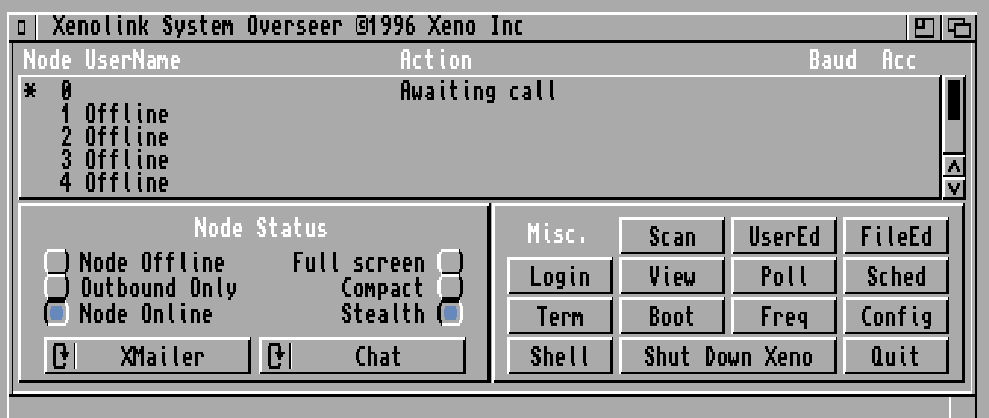
The heart of the operation was the System Overseer. Up top sat the lines with their state, below it the sysop's control panel: login, poll, configuration, terminal, shutdown. Most of the time it showed just one phrase, and everything came down to it: Awaiting call.
User administration
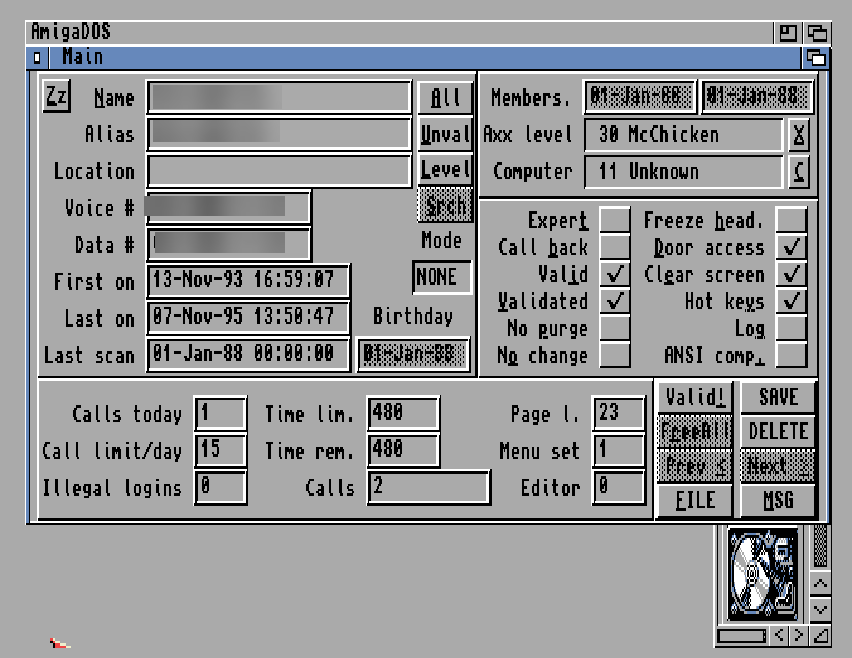
Behind every caller sat a record. The user editor shows just how fine-grained a mailbox was run: first and last call, calls per day, a daily limit, remaining minutes, access to the doors, and an access level. Those levels carried made-up names here, in this case 30 McChicken.
These screenshots, like everything here, are CC0 and free to use. More images are gathered under Impressions.
That's exactly why Xenolink is the key to the reconstruction today: the hard drive recovered in 2026 held the complete Xenolink system of the mailbox, including around 34,000 messages. From that came the browser-based demo, so close to the original because the original data was the template.